Learn Python for Free: The Best Websites and Channels for Beginners
However, the question on most beginners' minds is: Where do I start learning Python? And what are the best websites and channels offering free explanations and courses in Arabic and English?
Fortunately, learning programming no longer requires subscribing to paid courses or spending money on educational resources; there are many educational websites and YouTube channels that provide free content to help you learn Python step-by-step, starting from programming basics, writing code, variables, conditions, and loops, all the way to executing practical projects and applications.
In this guide from Information Spider, we have gathered the best free Python learning websites and channels, explaining the features of each source and the lessons and explanations they offer, whether you prefer learning in Arabic or English, so you can choose the right sources for your level and start your educational journey with confidence and at no cost.
If your goal is to specialize in artificial intelligence in the future, we also recommend checking out our previous guide: Learn Artificial Intelligence for Free from Scratch to Mastery | The Comprehensive Guide for Beginners – Lesson One (Learn AI from Scratch), to learn the basic steps that help you enter this field and how Python can be your gateway to understanding its technologies and developing its applications.
Why Does Python Rank First for Beginners and the Job Market?
Investing in learning a programming language requires understanding its technical and career returns. Python features key pillars that make it the most logical choice for a beginner:
- Clean and Expressive Syntax: Python adopts a drafting style very close to standard English with the use of indentation to enforce mandatory code organization. This removes the distracting complexity of brackets and semicolons, allowing the beginner to focus entirely on algorithms and problem-solving rather than fighting with the language's grammar rules.
- Overwhelming Popularity and Massive Standard Libraries (Batteries Included): Python provides thousands of ready-made packages and libraries via the
PyPIrepository. You don't need to program network connections or statistical formulas from scratch; libraries likerequestsandpandasaccomplish in two lines what takes dozens of lines in other languages. - Diversity and Functional Comprehensiveness: Learning a single language opens up multiple paths for you without needing to start from scratch when changing specializations; such as backend web development via
DjangoandFastAPI, office task automation (Scripting & Automation), data analysis and artificial intelligence usingNumPyandPyTorch, and penetration testing and cybersecurity. - Strong Community Support and Fast Troubleshooting: Any programming obstacle or error message (Traceback) you encounter while learning will have its discussions and solutions documented in detail on platforms like Stack Overflow and GitHub.
Best Arabic YouTube Channels for Learning Python from Scratch
Arabic programming content has witnessed great maturity, and the following channels provide a strong foundation in eloquent Arabic that saves you from paid courses:
1. Elzero Web School Channel (Osama Elzero)
The Python course provided by Osama Elzero is considered the most accurate and comprehensive Arabic reference for building concepts from scratch to an advanced level.
- Methodology: Concise and intensive lessons that isolate each concept away from distractions, focusing on understanding how the Python interpreter deals with memory and data.
- Strength Point: The system of assignments and practical challenges attached to each group of lessons via his website, which obliges the learner to practice and think independently.
- Optimal Path: Suitable for the absolute beginner who needs a proper foundation in programming logic, data structures, and Object-Oriented Programming (OOP) concepts.
- Direct Link: Visit Elzero Web School channel on YouTube
2. Hassouna Academy Channel
An ideal choice for learners who prefer elaboration and step-by-step progression through repeating live experiments in writing code.
- Methodology: A slow and organized teaching style that covers all details of functions, mathematical, and logical operations without assuming any prior background from the follower.
- Strength Point: Extensive practical applications that include building Graphical User Interfaces (GUI) via libraries like
Tkinterand connecting to relational databases such asPostgreSQLandSQLite. - Optimal Path: Anyone looking for a traditional application path starting with basics and ending with integrated desktop programs.
- Direct Link: Visit Hassouna Academy channel on YouTube
3. Mohamed Shoushan Channel
The course features a teaching style that removes the psychological barrier and fear between the beginner and the command line environment (Terminal/IDE).
- Methodology: Concise and practical explanations that avoid excessive theoretical complexity in the beginning, moving directly to executing basic operations.
- Strength Point: Clarity of idea sequencing and focus on concepts of functions, importing modules, and dealing with inputs and files.
- Direct Link: Visit Mohamed Shoushan channel on YouTube
4. Tarek Alabd Channel
Offers content based on an academic methodology combining learning Python with applying problem-solving and computer science skills.
- Methodology: Focus on algorithmic logic, data structures, and applying concepts in a way that qualifies the student for data science and machine learning paths later on.
- Direct Link: Visit Tarek Alabd channel on YouTube
Best Global YouTube Channels for Learning Python
For those wishing to benefit from resources in English, these channels provide advanced industrial and professional standards in writing code:
1. freeCodeCamp.org Channel
The prominent non-profit programming education platform. The channel includes comprehensive Python courses for beginners using the full-length video system spanning continuous hours, presented by prominent developers like Mike Dane and Beau Carnes.
- Feature: Building light practical projects at the end of each main section and comprehensive coverage of the basics inside a single visual reference.
- Direct Link: Visit freeCodeCamp channel on YouTube
2. Corey Schafer Channel
This channel is considered the gold standard for Python developers globally, and is highly recommended for the intermediate stage and beyond.
- Feature: Deep diving into advanced concepts: how
Decorators,Context Managers,Generatorswork, managing Virtual Environments, and building full-stack web applications usingFlaskandDjango. - Direct Link: Visit Corey Schafer channel on YouTube
3. Programming with Mosh Channel
Mosh Hamedani offers super simple explanations supported by graphics and diagrams highlighting data flow in code, with a focus on Clean Code practices.
- Feature: Fast pace, simplified English, and avoiding unnecessary fluff for the beginner in their first hours.
- Direct Link: Visit Programming with Mosh channel on YouTube
Top Interactive Websites and Platforms for Python Training
Passive video watching does not make a programmer; mastery depends on writing code, receiving immediate feedback, and correcting errors. The following table illustrates the most prominent trusted interactive platforms:
| Platform Name | Training Content Nature | Interactive Browser Environment? | Cost | Direct Link |
|---|---|---|---|---|
| LearnPython.org | Beginner-oriented curriculum divided into lessons and instant code exercises | Yes | 100% Free | learnpython.org |
| Exercism | Problem-solving challenge track with free human code review | Yes (CLI or Browser) | 100% Free | exercism.org/tracks/python |
| W3Schools | Quick educational references and instant code tests (Try it Yourself) | Yes | Free | w3schools.com/python |
| Kaggle Learn | Python oriented toward data science and handling arrays and tables | Yes (Jupyter Notebooks) | Free | kaggle.com/learn/python |
| Python Official Docs | Foundational guide and official language documentation from the original developers | No (Requires local environment) | Free | docs.python.org/3/tutorial |
Platform Analysis and How to Benefit from Them:
- LearnPython.org Platform: The best starting point for a beginner without needing to install any software on their device. You read the concept in specific points, then solve the programming test in a window at the bottom of the page to evaluate the correctness of the solution before moving to the next lesson.
- Exercism Platform: One of the most powerful tools for elevating programming level. It doesn't just offer automated tests, but provides a code review feature by volunteer mentors who show you how to write code in a more efficient and elegant way (Pythonic Style).
- Kaggle Platform: The fastest path for anyone learning Python with the goal of working in artificial intelligence and big data analysis; where you train directly inside a cloud-based
Jupyter Notebooksenvironment.
Roadmap to Learn Python and Master Its Basics in 30 Days
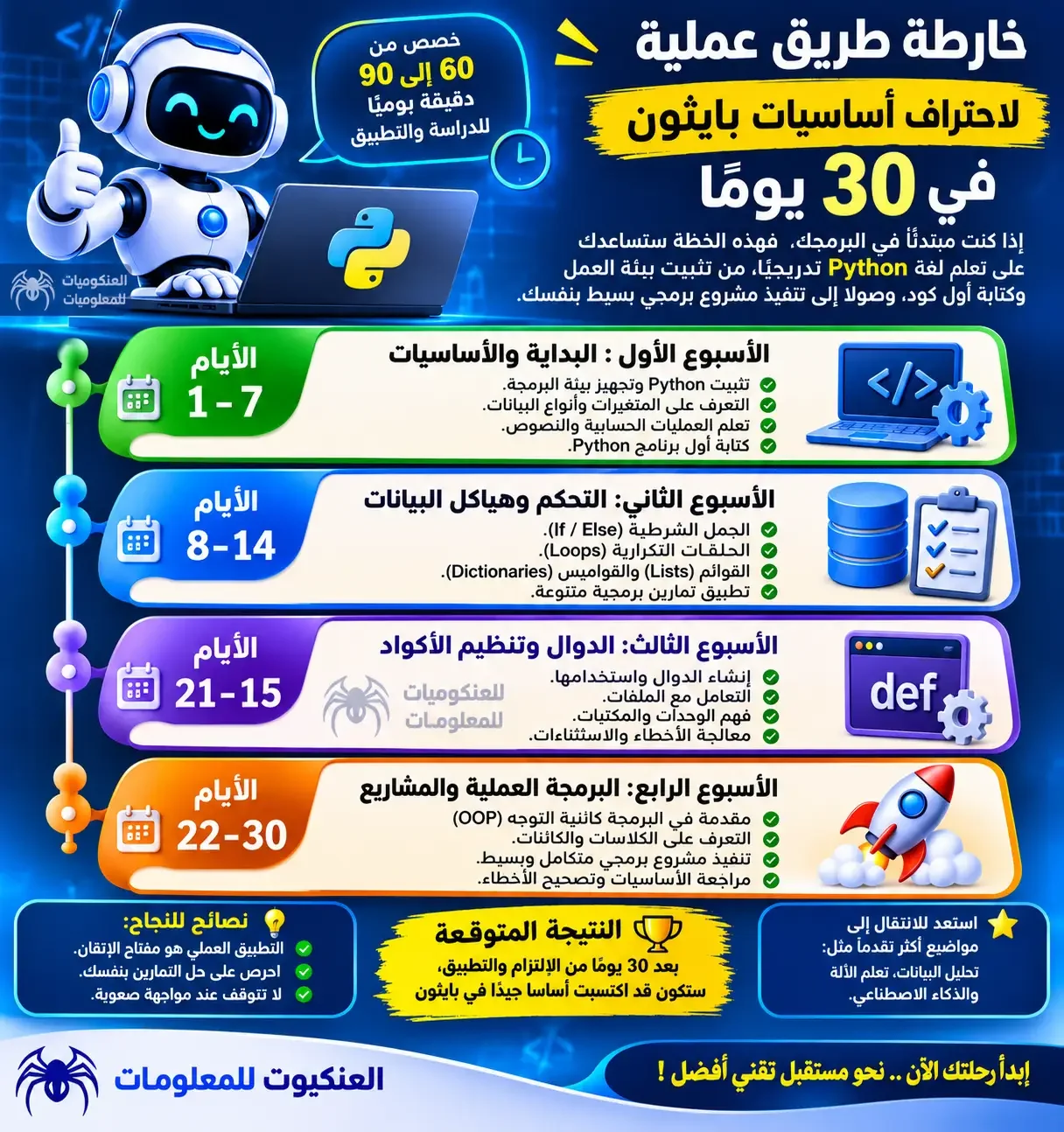
If you are a beginner in programming, this course will help you learn Python from scratch, starting from setting up the programming environment and writing your first line of code all the way to running a simple programming project by yourself.
Allocate 60 to 90 minutes daily for practical application, and focus on writing code every day instead of just performing the steps routinely.
Learning Stages in 30 Days
Week One: The Beginning and Basics
Days 1-7
- - Installing Python and setting up the programming environment.
- - Understanding data types and their characteristics.
- - Learning mathematical operations and language rules.
- - Writing the first Python program.
Week Two: Control Elements and Data Structures
Days 8-14
- - Conditional statements (if/else).
- - Loops.
- - Lists and dictionaries.
Days 15-21
- - Creating functions.
- - Handling files.
- - Understanding modules and libraries.
- - Exception causes.
Week Four: Free Trading and Projects
Days 22-30
- - Introduction to Object-Oriented Programming (OOP) paradigm.
- - Understanding classes and objects.
- - Executing a simple crash-proof programming project.
- - Reviewing events and determining their causes.
Week One: Foundation, Environment, and Data Types
- Install the latest version of Python and the Visual Studio Code code editor, and configure the Python Extension.
- Study variables and their naming rules, and understand basic data types (Strings, Integers, Floats, Booleans).
- Type casting, receiving data via the
input()function, and printing formatted outputs usingf-strings. - Arithmetic and logical operations and comparison operators.
Week Two: Conditional Statements, Loops, and Data Structures
- Control program flow via conditions:
if,elif,elseand compound logical expressions (and,or,not). - Finite loops
for loopsand conditional loopswhile loops, and controlling them viabreakandcontinue. - Basic data structures: Lists and operations on them (Slicing, Appending, Sorting).
- Tuples, Sets, and Dictionaries to organize complex data in the form of Key-Value Pairs.
Week Three: Functions, Importing Modules, and Error Handling
- Build custom functions using
def, pass default arguments, and return outputs viareturn. - Understand Local vs Global Scope of variables.
- Professional error handling and avoiding sudden program crashes via blocks:
try,except,finally. - Importing and utilizing built-in standard modules and libraries:
math,random,datetime,os.
Week Four: OOP Concepts and Building Your First Complete Project
- Introduction to Object-Oriented Programming: Classes, Objects, and using the constructor function
__init__. - Handling system files and storing and retrieving text data (Reading & Writing Files).
- First Practical Project (Choose one and execute it completely):
- A command-line application to manage tasks and expenses and save them in a text file or a
CSVfile. - An automated tool to scrape and analyze data from web pages (Web Scraper) using the
BeautifulSouplibrary. - A simple interactive Telegram bot that replies automatically and sends weather information via calling a Weather API using the
requestslibrary.
- A command-line application to manage tasks and expenses and save them in a text file or a
Crucial Programming Habits That Distinguish a Professional Developer from an Amateur
- Write Code Yourself and Avoid Blind Copying: Learning does not happen while reading or copying code, but while thinking about why a line of code was written this way, and dealing with typos and IndentationErrors.
- Reading Error Messages (Traceback) Consciously: Don't feel discouraged by red screens; the error message is your real guide to discovering the problem and identifying the causing line directly.
- Commitment to a Single Source Until the End: Hesitation between different courses is the primary reason for dropping out. Choose only one path from the mentioned sources and complete it entirely before searching for any additions.
- Immediate Transition to Personal Projects: Once you grasp the basics, start writing small tools that serve your daily work or solve a tangible problem you have; projects are the true proof of your programming ability, not completion certificates.
Conclusion: Start Your Programming Learning Journey Today
In the end, opening the door to mastery does not require huge budgets; learning Python for free from scratch has become available and within everyone's reach thanks to the abundance of open resources. All you need now is to choose a single path that suits you, whether by following the best YouTube channels to learn Python in Arabic to build the theoretical foundation, or practical training through websites to learn Python for beginners and writing code inside interactive platforms.
Always remember that commitment is the key to success; if you follow the Python learning roadmap and commit to daily practice, you will find that you have come a long way in understanding the basics of Python for beginners and preparing yourself for promising fields such as web development, data analysis, and artificial intelligence engineering. Don't wait too long searching for the perfect source, open your code editor and start your first programming experiment with your own hands now.