How to Maintain Scooter and Electric Bike Batteries at Home
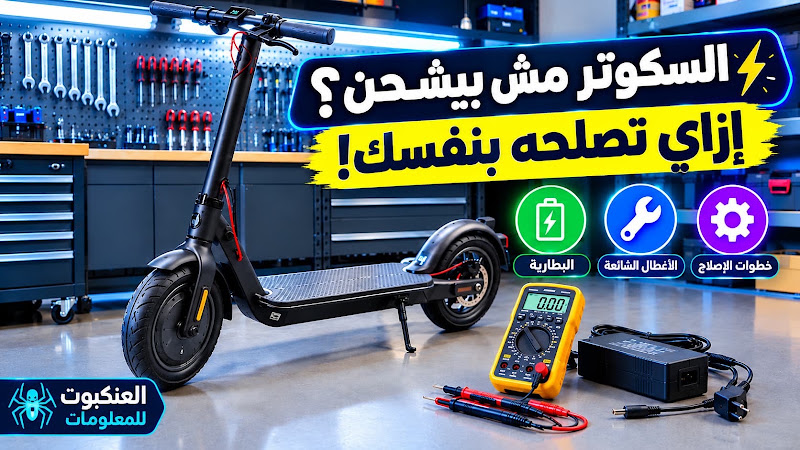
Comprehensive Practical Guide: Repairing electric scooter batteries in Egypt, Saudi Arabia, Iraq, and the Gulf, solving the problem of a scooter not charging with a green light, curing fast discharge and fake charging, balancing lithium BMS cells, and testing the home charger with a multimeter.
Scooter and Electric Bike Battery Maintenance at Home: Your Practical Guide to Fixing All Faults Yourself
Whatever your scooter type; the battery and charger system works on the same principle in all models
The battery is unquestionably the most expensive part of your scooter; its price alone equals 40% to 55% of the price of a brand-new device in the box. When it starts complaining, you suddenly find your trips disrupted: the scooter used to take you 30 km on a charge, and now it barely completes 8 or 10 km, or you find it cutting out in the middle of a bridge climb even though the display reads 50%! And the worst is when you put it on the charger and find the green light on without drawing a single drop of electricity.
In this practical guide via Spider for Info, we will explain to you in simple terms, step by step, how to diagnose your battery fault yourself, fix charging and balancing issues at home, and save the cost of a brand-new battery.
Quick Inspection Table for Scooter Battery Faults
| Your Apparent Fault | The Real Cause | Solution Method |
|---|---|---|
| Charger light is green and refuses to charge | Insulating dust in the socket, bent pin, or deep sleep | Dry cleaning and pin adjustment |
| Charge is 100% and as soon as you press the throttle it drops to half | Cell imbalance between lithium cells | Balancing cycle (BMS Cycle) |
| Scooter turns off on inclines and high speed | Loose main plug (XT60) or voltage sag | Tightening connection and insulating the plug |
| Charger buzzes heavily and gets blazing hot | Damaged voltage smoothing capacitors inside the charger box | Replace the charger immediately |
Step 1: Fixing the Problem of the Scooter Not Accepting Charge (Green Light Stays On)
When you plug the charger into the scooter and find its light stays green as if you plugged in nothing, do not rush and think the battery is burned; in 80% of cases, the problem is from the external socket and connection pins as Segway's official technical support guidelines regarding charging port safety explain:
Detailed Home Cleaning and Repair Steps:
- Cleaning the socket channel from dust and insulating mud: The charging port is close to the wheel, so with scooter movement, it collects dust and fine mud that forms an insulating layer preventing electricity. Turn off the scooter, get a wooden toothpick or a completely dry toothbrush, and gently clean the opening and pull out dirt clumps. (Warning: Never touch the pins with any nail or metal screwdriver to avoid creating a short circuit that burns the internal battery fuse).
- Adjusting the internal copper pin of the charger cable: Look with your mobile flash inside the charger plug; frequent plugging and unplugging makes the internal copper pin bend to the side or widen and not touch properly. Use a wooden stick and gently push it back to the exact center of the opening to touch properly in the socket.
- Curing deep discharge (waking up a sleeping battery): If the scooter was parked for months while empty, the voltage drops below the safety minimum, so the smart charger cuts protection and outputs no electricity. The solution here is to take it to a maintenance technician to connect it to a direct power supply for a quarter of an hour to raise the voltage to 30V, and afterwards your regular charger will work with it very normally.
Step 2: Curing Fake Charging and Balancing Battery Cells (BMS Balancing)
Many scooter users complain: "The scooter charges to 100%, and as soon as I ride for 5 minutes, I find it suddenly dropped to half!". What is the scientific reason behind this in simple terms?
The battery of any scooter in the world is a pack made of 30 to 40 small lithium cells (most famously 18650 or 21700 cells). With daily charging, some cells charge faster and reach 4.2V while other cells are still at 3.7V. The smart safety board (BMS) is programmed to cut charging as soon as the fastest cell fills up, so the scooter shows 100% on the screen while the real half of the battery is empty! To learn more about balanced charging chemistry, you can review Battery University's detailed lithium-ion charging studies.
Steps for the Slow Balancing Cycle at Home (to restore battery torque and range):
- Quiet discharge: Ride the scooter on Eco mode until the battery reaches 20% (avoid letting it completely die to 0%).
- Mandatory cooling period: Let the scooter rest for half an hour in a moderately warm place until the cells completely cool down from the trip heat.
- Extra charging after the green light: Put the scooter on the original charger, and when the light turns green (100%), leave it connected for 2 to 3 extra hours on electricity. During these hours, the BMS board runs balancing resistors with a very weak current that absorbs the excess and charges the deficient cells until they are all precisely equal.
Repeat this step once a month, and you will be surprised that the traveled range (kilometers) increased by an extra 5 to 10 km.
Step 3: Checking the Home Charger and Measuring Voltage with a Multimeter
Many times we blame the battery while it is fine, and the fault lies in the charger box and its internal capacitors. To be sure yourself, get a multimeter and set it to DC Voltage (DC Voltage 200V), and measure the two terminals of the charger plug while it is connected to electricity:
- 36V battery chargers (Xiaomi, Ninebot, and most popular scooters): The charger must measure exactly 42.0V. If it measures less (e.g., 38V or 39V), this charger is damaged, does not finish charging the battery, and must be replaced.
- 48V battery chargers (fast Joyor and Kugoo scooters and electric bikes): It must measure exactly 54.6V.
- Checking the yellow power plug (XT60): If your scooter suddenly cuts out on inclines and speed, unscrew the bottom deck cover screws, and look at the yellow plug connecting the battery to the motor; if you find loose pins or melted plastic from heat, secure it well or replace it with a new original plug because it leaks high current on inclines.
Step 4: Understanding Lithium Cells and Internal Temperature Sensors
Lithium battery packs have precise temperature sensors (NTC Thermistors) glued to their insides. The function of this sensor is to give an immediate command to the controller: "Shut down charging and cut electricity immediately if the temperature rises above 50 degrees Celsius". Therefore, there are two golden rules you must follow to protect the battery:
- Never charge the scooter immediately after a long trip in the summer sun: The cells are very hot; as soon as you plug in the charger, the sensors will cut charging, or the cells will be damaged and lose efficiency forever. Wait 20 minutes to cool down and then connect the charger.
- Washing the battery area with water is prohibited: The scooter is resistant to light splashes, but washing it with a water hose or going into deep water puddles on the street allows water to sneak into these circuits and cause a short circuit that burns the safety board instantly.
Table of Voltage and Real Range for Popular Scooter Models
| Model and Type | Nominal Battery Voltage | Healthy Charger Voltage | Realistic Charge Range |
|---|---|---|---|
| Xiaomi M365 / 1S / Essential | 36V (7.8Ah) | 42.0V | 18 - 22 km |
| Xiaomi Pro 2 / Mi 3 / 4 Pro | 36V (12.8Ah) | 42.0V | 30 - 38 km |
| Ninebot Segway Max G30 | 36V (15.3Ah) | 42.0V | 45 - 55 km |
| 48V Scooters and Bikes (Joyor / Crony, etc.) | 48V (13Ah - 18Ah) | 54.6V | 35 - 50 km |
Frequently Asked Questions and Technical Answers
Can I buy a 4A fast charger instead of 2A to charge in two hours?
This is not recommended at all unless the catalog allows it; because raising the amperage to 4A or 5A on small cells generates high internal heat that reduces battery life from 3 years to 1 year, and may burn the charging lines in the BMS board.
What is the normal lifespan of a scooter battery before I need to replace it?
Original batteries live between 500 to 800 full charge cycles. This means if you charge the scooter every other day, it will easily last you from 3 to 4 years before its capacity begins to gradually decrease by 20% annually.
How do I maintain the scooter battery if I won't use it all winter?
Charge the scooter to exactly 60% and park it in a moderately warm place, and every two months put it on the charger for half an hour and return it to 60% to protect it from clinical death and deep discharge.
⚠️ Serious Security Warning You Must Never Take Lightly:
All previous steps are external preventive maintenance.. Never, and I mean never, peel off the blue insulating wrap of the battery or tamper with the cells using ordinary screwdrivers inside your home!
A scooter battery is not a toy; it is a dense pack of high-energy, highly flammable lithium-ion cells. If a metal screwdriver tip touches two poles and creates a "short", or a cell is accidentally punctured, a catastrophic chain chemical reaction called Thermal Runaway occurs. Within just 10 seconds, the battery turns into a fountain of fire and toxic smoke with a temperature exceeding 900 degrees Celsius, and this fire cannot be extinguished with regular water and requires dry sand; to learn about safety protocols, you can review National Fire Protection Association (NFPA) warnings regarding scooter and electric bike batteries.
Extreme danger signs that require stopping immediately:
- If you find the battery swollen and bowed on the side: Never think of puncturing the bulge with a pin to "vent it"; because oxygen entering the damaged cell will ignite it in seconds!
- If you smell burning plastic or a strange chemical smell stinging your nose coming from under the deck.
- If you feel scorching heat on the external body of the scooter during charging.
Correct action during danger: Disconnect the charger immediately, move the scooter to an open balcony or outdoor area away from any upholstery or carpets, and leave it to cool in the open air. Contact a specialized electric vehicle battery technician immediately who possesses a spot welder and certified chemical insulation equipment. Your safety and your family's safety comes first and foremost above any device.